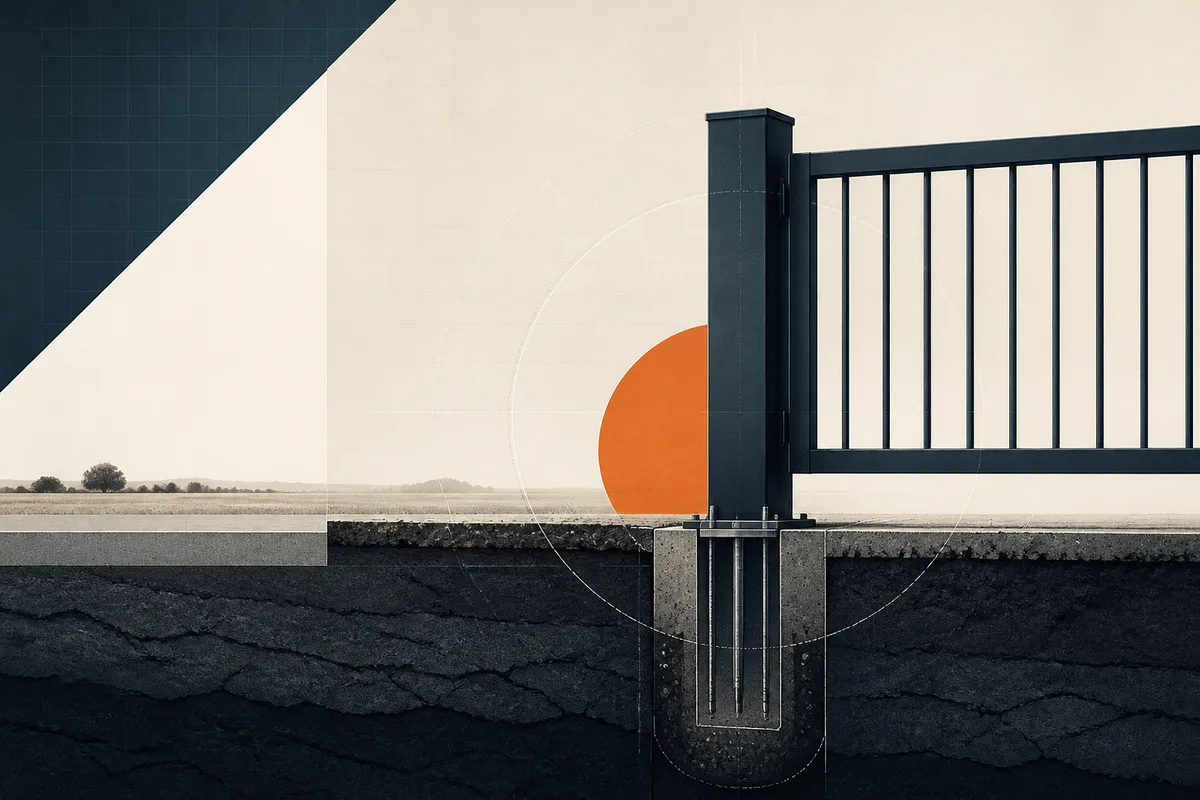
Stabilizing Gate Posts in Blackland Prairie Clay
Homeowners in the North Texas corridor often discover that a perfectly functioning gate in the spring becomes a grinding, stuck liability by the heat of August. This isn't usually a mechanical failure of the gate itself, but a geological one driven by the highly expansive Blackland Prairie clay. When the soil loses moisture during a typical Texas summer, it shrinks and pulls away from concrete footings, leaving gate posts to lean under the weight of heavy steel or wood panels.
This guide breaks down the mechanics of soil-driven gate failure and the technical requirements for permanent stabilization. It is written for property managers and homeowners in the Plano Service Area who need to distinguish between a temporary adjustment and a long-term foundation fix.
Why Standard Gate Footings Fail in North Texas Clay
Standard construction practices that work in sandy or stable loamy soils are insufficient for the unique demands of Collin County. The primary drivers of gate failure in this region include:
- High plasticity index (PI) clay expands significantly when wet and cracks deeply when dry, creating a "heaving" effect on shallow concrete bases.
- Inadequate drainage around the gate entrance allows water to pool at the base of the post, accelerating soil softening and post-lean.
- The heavy weight of automated sliding or swinging gates acts as a lever, amplifying even a one-degree shift in the foundation.
- Fluctuating temperatures cause vinyl and wood materials to expand, which, combined with shifting posts, puts immense stress on gate latches.
The Playbook for Permanent Gate Post Stabilization
Solving a misalignment issue requires a shift from superficial repairs to sub-surface engineering. Follow these steps to ensure a gate remains plumb regardless of the weather.
1Identify the Direction of the Shift
Examine the gap between the gate and the latch post; if the gap is narrower at the top than the bottom, the hinge post is likely leaning inward. Use a level on all four sides of the post to determine if the movement is lateral or longitudinal, as this dictates where the soil reinforcement must occur.
2Assess the Mechanical Impact
Before digging, check if the shift has already damaged the automation system. Soil movement can pull a gate off its track or cause a Gate Operator Repair to be necessary due to the motor trying to force a bound gate.
3Implement Deep-Footing Reinforcement
Standard post holes are often dug too shallow for the North Texas environment. A stable gate post in this region typically requires a footing that reaches deeper into the ground to anchor in soil with more consistent moisture levels. This prevents the "floating" effect common with shallow 24-inch pours.
4Optimize Soil Moisture Consistency
Maintaining a consistent moisture level around the gate foundation can prevent the drastic shrinking that leads to post-lean. Professional installations often include a "bell-bottom" pier design, where the base of the concrete footing is wider than the top to resist upward heaving.
5Adjust for Seasonal Variance
Once the post is stabilized, hardware should be set to allow for minor seasonal tolerances. Utilizing heavy-duty adjustable hinges allows for small tweaks without needing to reset the entire foundation every three years.
The Blackland Prairie Impact
The soil in North Texas is primarily composed of Houston Black clay, famous for its "shrink-swell" capacity. During dry spells, the ground develops deep fissures; during heavy rains, these fissures fill, and the soil expands with immense force. According to research on Plano fence repairs, this movement is the leading cause of gate failure. If a post is not anchored below this active zone, it will inevitably move.
A numerical value representing the range of moisture content over which a soil behaves plastically; higher PI values indicate greater potential for gate post-shift.
How Gate Repair of Plano Helps
Addressing a leaning or stuck gate starts with a comprehensive site assessment to determine if the issue is mechanical, structural, or geological. A typical scope of work for gate post repair in Plano involves excavating the failed footing, resetting the post with reinforced concrete, and realigning the gate to ensure the motor operates without resistance. Property owners should have information ready regarding the age of the gate and any history of foundation repair on the primary structure, as these often correlate. You can reach the team at +19453359880 to discuss specific site conditions.
Frequently asked questions
Why does my gate only stick during the summer months?
As the clay soil in North Texas dries out, it shrinks and pulls away from the concrete footing, causing the post to lean toward the weight of the gate. This shift narrows the latch gap, making it difficult for the gate to close or lock properly.
Can I fix a leaning gate post by just adding more concrete at the top?
No, adding concrete to the top often creates a "mushroom" head that gives the expansive soil more surface area to push against. The correct approach is to ensure the footing is deep enough and narrow at the top to minimize soil contact in the active zone.
How do I know if I need a new motor or just a post repair?
If the gate moves freely when disconnected from the operator but struggles when attached, the issue may be the motor. However, if the gate physically hits the post or drags on the ground, the foundation is the primary culprit and must be addressed first.
Does the type of gate material affect how much the post shifts?
Yes, heavy ornamental iron gates exert more leverage on a post than light aluminum or wood gates. The heavier the gate, the more robust the underground footing must be to counteract the lateral pressure of shifting clay.
What is the standard depth for a gate post in Plano?
While many builders use a standard depth, local soil conditions often require footings to reach 36 to 48 inches to find stable ground. Proper gate post repair in Plano requires accounting for these specific geological factors to prevent recurring alignment issues.
What happens when you get in touch: you describe the situation, we ask the few questions that actually change the answer, and you get a clear scope and next step — no obligation.